The Evolution of Workplace Technology: Shaping the Future of Productivity
The Evolution of Workplace Technology: Shaping the Future of Productivity
The modern workplace is no longer a physical location you commute to; it is an ecosystem powered by bits, bytes, and high-speed connectivity. As we move further into 2026, the line between “work” and “technology” has effectively vanished.
For a platform like TechVista AI, understanding this evolution is key. Workplace technology is no longer just about having a faster laptop it’s about how AI, automation, and collaborative tools are reshaping the human experience at work.
The Pillars of Modern Workplace Technology
To understand where we are going, we have to look at the specific technologies driving the change. It isn’t just one software; it is a stack of tools working in harmony.
1. The Integration of Generative AI
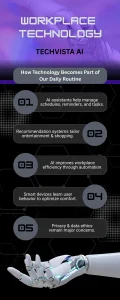
Artificial Intelligence has transitioned from a “cool experiment” to a non-negotiable teammate. In 2026, we are seeing AI move beyond simple text generation into Agentic Workflows. These are AI agents that don’t just write emails but can actually manage schedules, pull data reports across different platforms, and even handle basic project management tasks without constant prompting.
This shift allows employees to move from being “doers” to “orchestrators.” Instead of spending three hours building a spreadsheet, a professional now reviews the data synthesized by an AI agent, focusing their energy on the “why” rather than the “how.”
2. Hyper-Collaborative Digital Spaces
The “Zoom fatigue” of previous years has led to more immersive collaborative environments. We are seeing a rise in asynchronous communication tools that allow teams across different time zones to work on the same digital canvas.
Digital whiteboards and collaborative document editors have become the primary “office” for most knowledge workers. These tools now use AI to summarize long meeting transcripts and highlight “action items,” ensuring that if you missed a live session, you can catch up in minutes rather than hours.
3. Sustainable and Smart Offices
For those still heading into physical offices, the technology has become “invisible.” Smart sensors now manage lighting and temperature based on occupancy to save energy, while IoT (Internet of Things) devices track desk usage to optimize office layouts. This “PropTech” (Property Technology) ensures that the physical workspace is as efficient as the digital one, directly contributing to a company’s ESG (Environmental, Social, and Governance) goals.
The Psychological Shift: Technology for Wellness
One of the most significant updates in 2026 is the focus on Digital Well-being. In the past, technology was blamed for burnout; today, it is being designed to prevent it.
Predictive Burnout Analytics: Advanced HR platforms now analyze communication patterns (not content) to identify signs of exhaustion. If an employee is consistently responding to messages at 2:00 AM, the system can flag this to management to encourage a better work-life balance.
The “Right to Disconnect” Features: Operating systems now include sophisticated “Work Modes” that hard-block professional notifications after hours, helping employees mentally transition away from their tasks.
Augmented Reality (AR) for Training: Instead of reading dry manuals, new hires use AR headsets to “learn by doing” in a simulated environment. This reduces the anxiety of starting a new role and speeds up the onboarding process significantly.
Security in a Decentralized World
As the workplace stretches across the globe, the perimeter of the “office” has disappeared. This has made Cybersecurity a core pillar of workplace technology.
The move toward Zero Trust Architecture means that “identity is the new perimeter.” In 2026, we rely less on easily hackable passwords and more on passkeys and biometric authentication. For the average worker, this means a smoother experience: your laptop recognizes you instantly, but the “bad actors” find it nearly impossible to penetrate the company network. This invisible layer of safety allows teams to work from a coffee shop in Bali or a home office in Dhaka with the same security level as a bank headquarters.
The “Phygital” Work Revolution
The “Phygital” (Physical + Digital) model is the ultimate expression of workplace technology. It recognizes that some tasks are better done in person like high-stakes brainstorming or team bonding while others are optimized for deep-focus remote work.
Cloud computing is the backbone here. With 5G and early 6G trials, the “office” is wherever there is a signal. This mobility allows for a global talent pool, where a company can seamlessly collaborate with specialists worldwide in real-time. We are no longer limited by our geography; we are only limited by our connectivity.
Frequently Asked Questions (FAQ)
1. What is the most important workplace technology in 2026?
Ans: While many point to hardware, Generative AI integration remains the most transformative. It is the “glue” that connects data, communication, and productivity, allowing humans to focus on creative strategy rather than administrative busywork.
2. Does workplace tech replace human jobs?
Ans: No, it shifts the nature of the job. Technology handles the high-volume, low-context tasks (data entry, scheduling), while humans remain essential for low-volume, high-context tasks (empathy, ethics, and complex decision-making).
3. How can small businesses afford high-end workplace tech?
Ans: The “SaaS” (Software as a Service) model has democratized tech. Small businesses can now access the same enterprise-grade AI and cloud tools as Fortune 500 companies through affordable monthly subscriptions.
4. What is “App Fatigue” and how do we fix it?
Ans: App fatigue happens when employees spend more time switching between tools than actually working. The fix is consolidation—using platforms that offer multiple features (chat, video, docs, project management) in a single, unified interface.
5. Is cybersecurity part of workplace technology?
Ans: Absolutely. As work becomes more decentralized, Zero Trust Architecture has become a standard workplace technology. Every device and login is verified, ensuring that company data remains safe even when employees work from public networks.